
English| EUR
Suggested for you
More currencies
Choose a language
The herds never stop moving, which is why the answer here is a coordinate as much as a calendar date. This serengeti safari best time to go guide explains what shifts across the year, what stays constant, and how the park's daily rhythm shapes a short Northern Circuit itinerary.
Quick answer
Park gates operate 06:00–18:00 every day, and the recommended arrival window is 06:00–09:00, when wildlife activity peaks and temperatures stay cool before the midday heat. Across the year, the drier months concentrate game near permanent water and push the herds toward the northern rivers, while the green season favours calving and birdlife. The caveat: region matters more than month.
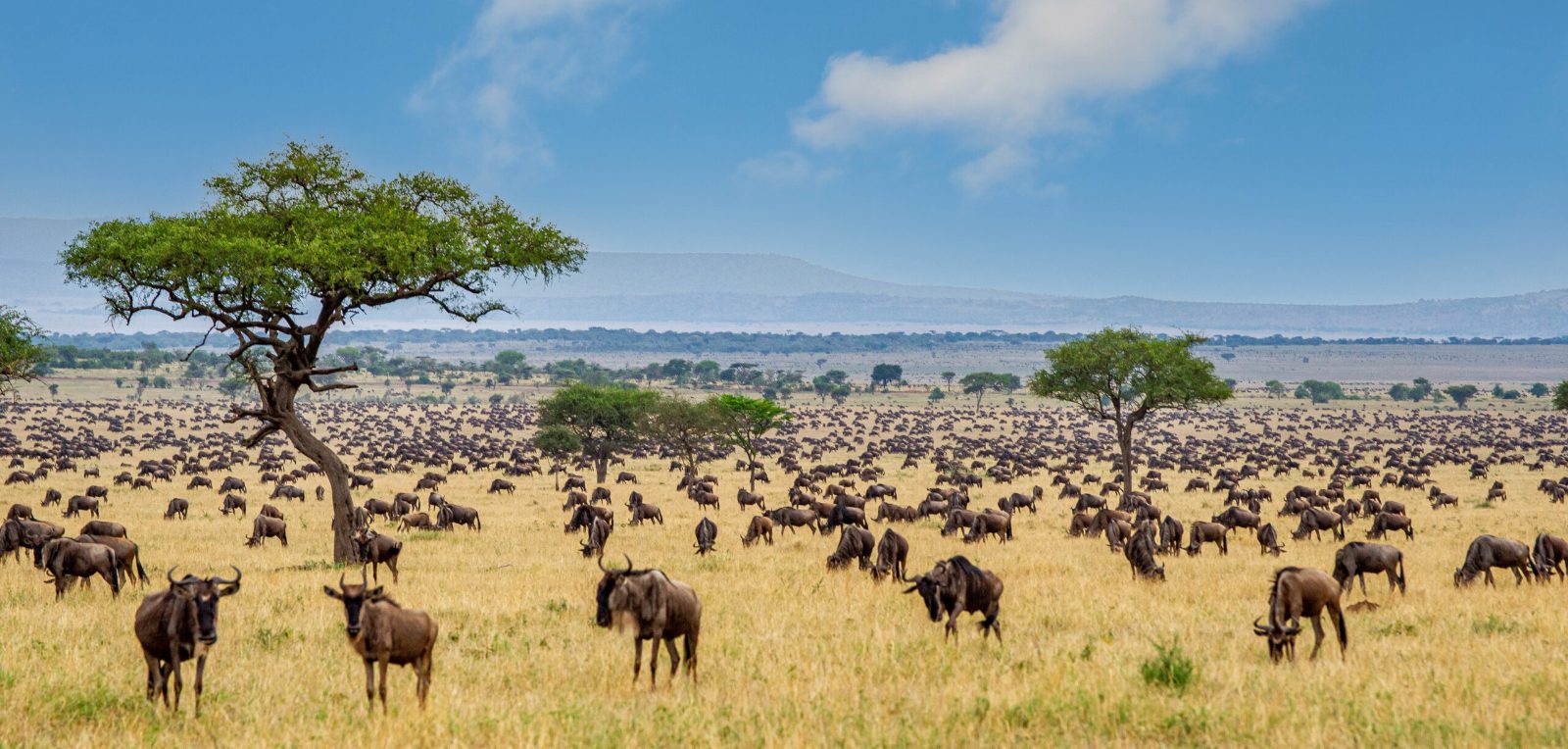
The Serengeti does not have a season in the way a museum has a closing day. Its plains carry roughly 1.3 million wildebeest and some 200,000 zebra on a continuous clockwise loop, which means the animals are always inside the ecosystem — only their coordinates change. That single fact reframes the serengeti safari best time to go question entirely. Travellers rarely need to choose between a good year and a bad one. They need to match a date to a district: the short-grass plains around Ndutu, the woodlands and granite kopjes of the Seronera Valley, the Grumeti in the west, or the Mara River in the far north near Kogatende. Rainfall drives the loop. The long rains and the short rains pull the herds toward fresh grazing, and the grass in turn dictates where predators concentrate, which is why lion, cheetah and spotted hyena sightings change address rather than disappear. A Northern Circuit safari tour usually stitches this movement together with the Ngorongoro Crater and Lake Manyara, so the calendar question seldom stands alone; it sits inside a route. The park was gazetted in 1951 and inscribed as a UNESCO World Heritage Site in 1981, and its layout still reflects that age: Naabi Hill Gate on the southern boundary, a scatter of airstrips, and long gravel distances between camps. Swahili speakers call these plains siringet, the place where the land runs on forever, and the driving times bear the name out. What should a reader do with the answer? Fix the region first, then the dates, then the length of the trip. A three-day framework rewards proximity, so a camp close to the herds beats a longer transfer every time. Conservation-area rules and permit conditions are set by the park authority rather than by operators, and are published at tanzaniaparks.go.tz, so they are worth verifying before committing to anything. Forecasts are less useful here than herd reports; guides track grazing conditions week to week, and a reputable operator will say plainly when a requested date does not suit a requested corner of the park. The sections that follow carry the practical detail — daily hours, costs, routes, sequencing and the packing list — and this page is the frame around them. For most first-time visitors the serengeti safari best time to go is simply the window when their chosen stretch of the ecosystem is at its busiest with animals, not the window that appears most often in brochures.
“The animals are always inside the ecosystem — only their coordinates change.”
The period from late June to October is widely considered the optimal time for a Serengeti safari, offering the best wildlife visibility as animals congregate around water sources during the dry season. This window aligns with the Great Migration's movement through the northern regions, providing opportunities to witness river crossings.
Dry, 15°C to 27°C
Sparse vegetation improves visibility; Great Migration herds are active.
Humid, 18°C to 29°C
Brief afternoon showers revitalize landscapes; arrival of migratory birds.
Rainy, 17°C to 28°C
Lush greenery and calving season; lower visitor numbers offer solitude.
—
Early hours provide cooler temperatures and peak wildlife activity.
Verdict: For the highest density of wildlife and predictable weather, visit between July and September during the weekday, arriving at the park gates at 06:00.
This three-day flow suits first-time visitors covering the Serengeti's central and northern sectors on a fixed itinerary, with two nights inside the park. Each day runs roughly from the 06:00 gate opening to the 18:00 close, structured around the two game-drive windows when animals move most.
Clear the gate within the 06:00–09:00 arrival window, allowing 30–45 minutes for registration and permits. Climb the short Naabi Hill trail for an orientation view over the southern plains before driving on.
Drive north into the Seronera Valley with stops as wildlife appears, roughly three to four hours including a picnic break. Keep the roof hatch closed on the open stretches — the dust is constant.
Work the Seronera River loops for the late-afternoon movement toward water, about two hours. Budget 30 minutes to reach camp before the 18:00 close.
Leave camp at first light for the Moru Kopjes, where lions rest on the rock outcrops. Three hours out, returning to camp for a late breakfast and midday rest.
Return out for the Retina Hippo Pool and the Seronera riverine woodland, roughly two and a half hours. Bring a fleece — temperatures drop quickly after sundown.
Break camp early and drive the Lobo or Grumeti sector depending on where herds are reported, four to five hours with continuous game viewing.
Allow two hours back to your exit gate with a margin before 18:00. Confirm your onward transfer the evening before — mobile signal is unreliable in the north.
Serengeti National Park operates daily, providing access for wildlife observation throughout the year. Adhering to the recommended arrival window ensures optimal conditions for viewing activities.
Access to Serengeti National Park requires payment of official conservation fees. These fees are calculated on a per-person, per-24-hour basis.
Verdict: A typical adult pays 82.6 USD plus 18% VAT per 24-hour period, with total costs depending on the duration of the stay.
Serengeti National Park is located in northern Tanzania, typically accessed via Arusha. Most travelers reach the park by light aircraft or road transport through the established Northern Circuit network.
B144 road from Arusha via Ngorongoro Conservation Area
Charter flight from Arusha Airport (ARK) to Seronera Airstrip
Public transport to Arusha followed by private safari vehicle transfer
Plan your journey to ensure arrival between 06:00–09:00, as this window provides the best wildlife activity and cooler temperatures before the midday heat.
Sort these documents, health requirements and gear items in the weeks before departure so nothing holds you up at the park gate.
Everything you need to know about serengeti safari best time to go
The serengeti safari best time to go is generally during the dry season, from late June to October, when wildlife congregates around water sources. This period offers clearer visibility and easier navigation for your Northern Circuit Safaris excursion.
The park is open daily from 06:00 to 18:00. This schedule allows visitors to maximize their time in the field for early morning and late afternoon game drives.
The official entrance fee is 82.6 USD per adult per 24 hours. Please note that this conservation fee excludes the required 18% VAT.
For the most productive wildlife sightings and to avoid midday heat, the best arrival window is between 06:00 and 09:00. Arriving early ensures you are on the savannah when predators are most active.
While wildlife is present year-round, the Great Migration typically moves through different sectors of the park depending on the time of year. Understanding these movement patterns is crucial when determining the serengeti safari best time to go.
The wet season, primarily from November to May, brings lush vegetation and migrant birds, though some tracks may become difficult to navigate. Choosing the right month depends on whether you prioritize dry weather or verdant, quiet landscapes.
Proper planning involves coordinating your transport to arrive within the official park hours. Ensure your itinerary accounts for these timing requirements to make the most of your visit to this renowned Tanzanian landmark.
3 Day Serengeti and Ngorongoro Safari
Read more GuideIs a Serengeti Safari Safe?
Read more Tickets & tours3-Day Serengeti Safari from Arusha
Read more Tickets & tours3-Day Serengeti Safari from Zanzibar
Read more Guide3-Day Serengeti Safari Price & Cost
Read more Tickets & tours3-Day Serengeti Fly-in Safari
Read more